
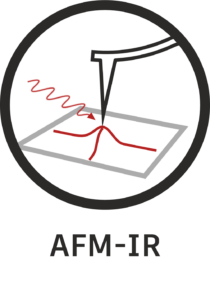
 Atomic force microscopy-infrared spectroscopy (AFM-IR) is an analytical technique that combines the topographic imaging with high spatial resolution provided by atomic force microscopy (AFM) with the chemical identification capabilities of infrared spectroscopy (IR). It enables the mapping and identification of the chemical composition of materials at the nanoscale, typically with a resolution of 20 – 100 nm. The technique works by using a tunable infrared laser to excite a sample, causing localised thermal expansion which is detected by an AFM tip. This consequently enables nanoscale chemical analysis and bypasses the traditional diffraction limit.
While both sSNOM and AFM-IR can identify the chemical composition of samples at the nanoscale, the key difference between the two techniques is that sSNOM relies on optical detection, whereas AFM-IR uses purely mechanical detection. Please note that AFM-IR is often referred to as PTE, PTIR, PiFM or PiF-IR in the literature.
The technique’s working principles include:
Irradiation: a tunable, pulsed infrared (IR) laser illuminates the sample. When the wavelength of the laser matches the frequency of a vibrational transition in the material under the tip, the material absorbs the radiation.
Photothermal expansion: the absorbed energy creates a localized temperature increase, causing the sample to expand rapidly.
Detection: an AFM probe detects this microscopic expansion as a rapid mechanical force acting on the tip, and resulting in cantilever oscillation.
Chemical mapping and spectroscopy: by tuning the laser through different wavelengths, the system records an absorption spectrum (analogous to conventional infrared absorption spectroscopy) for the exact spot under the tip. This is used to determine the composition of unknown samples. Keeping the laser at one specific frequency, while scanning the surface, creates a high-resolution ‘chemical map’ of the sample.
AFM-IR is an effective method of chemical characterisation at the nanoscale, where conventional FTIR often lacks the necessary resolution and sensitivity. This method is highly effective in determining the components of polymer blends, identifying species and studying the structural properties of heterogeneous materials such as rubber-tyre blends, food packaging and adhesives. In the life sciences, it is used to analyse the secondary structure of proteins, bacteria and single cells in biological systems, including studies in water at a subcellular level. Furthermore, AFM-IR can be used to analyse defects, identify contaminants, map chemical changes at interfaces (e.g. Si/SiO₂), and assess local strain in low-dimensional materials. Its high sensitivity enables the characterisation of single-layer chemical films, nanoparticles, and phase changes in crystalline materials.
REFERENCES AND APPLICATIONS OF IR NANO-IMAGING AND -SPECTROSCOPY
[1] Soft matter
[2] Biomaterials
[3] Polymers